How to train your dog to greet guests
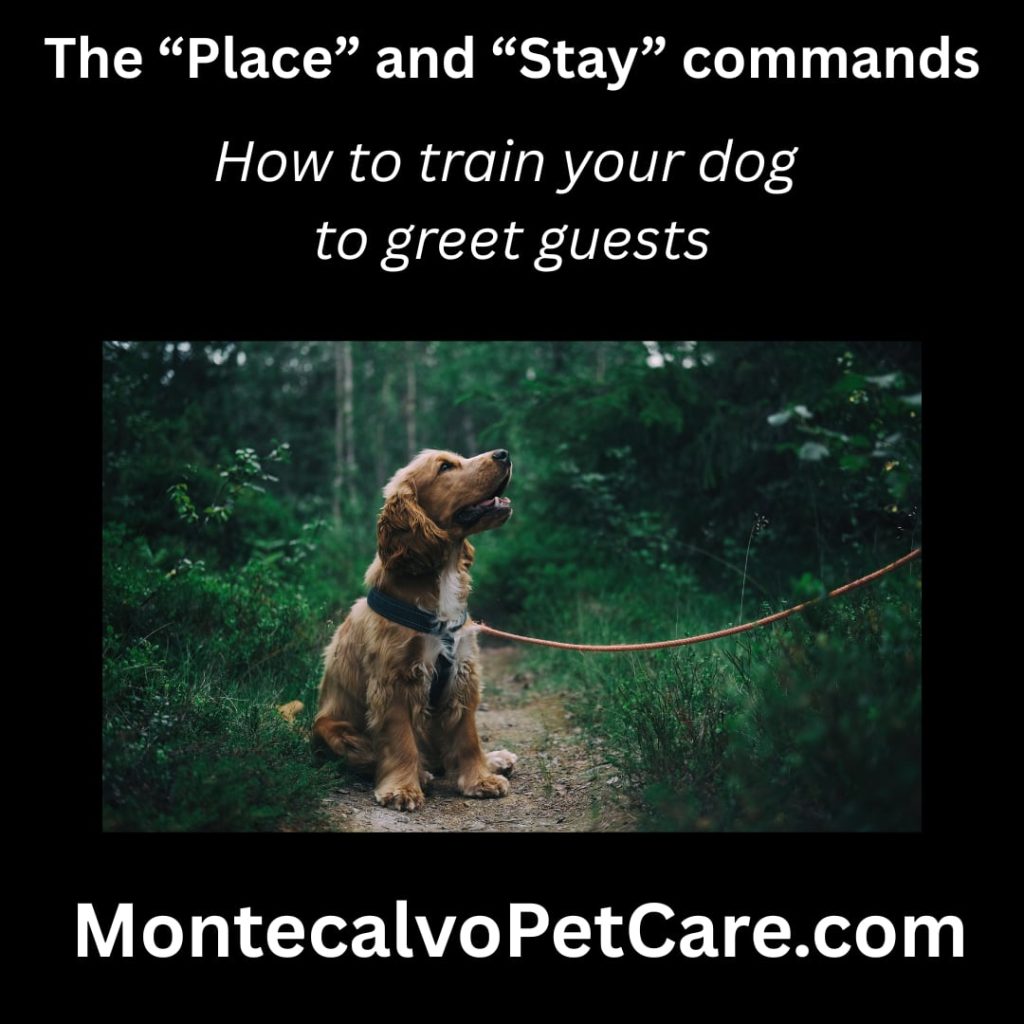
Holidays can provide extra excitement – and with it extra stress – for dogs. This holiday I’d like to highlight two of the hardest to teach commands, the “Place” and “Stay” commands and how they can make interactions easier. In the book “Decoding Your Dog”, one of the authors, Katherine Albro Houpt, VMD, PhD, DACVB wrote:
Combining “Place” and “Stay”
Chose a spot ten feet or so from the door. The perfect spot varies with the architecture of your house. For example, if the stairs in your house end close to the front door, you may have to teach your dog to go to the sixth stair.
Your first step would be to call him to the spot you chose and say “place” as he arrives, at which time he gets a treat. After a few repetitions you would then say “place” and pat the area, and when he comes give him his treat. Finally, you would go to the door and say “place” and have your dog go to his spot for his treat.
Your final step would be to add “stay,” so that your guests could get all the way in the house and then greet your dog. The added benefit is that your dog is unlikely to run out the door and down the street if he is staying in his spot away from the door.
I think Houpt makes a good point; the place command can give the dog the needed time to process all that extra anxiety while also giving the hosts time to explain the dog’s greeting routine – as well as any other quirks – to unfamiliar guests.
In my experience as a dog-sitter I make it a point to train impulse control and relieving dog anxiety because controlling impulse and anxiety is the first step to teaching a dog patience.
I have learned that people often get very excited in greetings – the dogs feed off this energy creating a self-reinforcing loop where the excitement escalates very quickly.
If you ever need a dog-sitter, a dog-trainer or a dog-walker please contact montecalvopetcare.com at contact-form or call/text 514-979-5406 or email. We work with all dogs large and small, any breed. We work on impulse control and doggie introductions.
We also teach commands for dog safety. For example the “drop it” command to be used when the dog takes something into it’s mouth that it’s not supposed to. We teach how to make situations safer for everyone to be around the dog. For example we train dogs to wait until they are told to cross streets. We also have a speciality service for rescue dogs. This means we work on making the rescue dog feel safer in more environments and situations.
We are located in the heart of Notre-Dame de Grace (NDG) near the Montreal-West train station
If you would like to buy “Decoding Your Dog: Explaining Common Dog Behaviours and How to Prevent or Change Unwanted Ones” by American College of Veterinary Behaviorists published by Mariner books click here
Leave a Reply